
 Spatial Modeling & Analysis Research Cluster (SPARC), Department of Geography, Universitas Indonesia
I spend most of my time staring at street-view images (SVIs), trying to figure out what they can tell us about cities. Currently, I work as a researcher at SPARC, Department of Geography, Universitas Indonesia, somewhere between computer vision, urban geography, and spatial approaches with a soft spot for SVI applications, streetscapes, and the small visual details that make a street feel like a place.
I studied Geography at Universitas Indonesia for both my B.Sc. and M.Sc. (fast-track program), focusing on urban context research. I've had the chance to teach a bit, mentor some undergraduate students, and write papers on things like green space equity and street-view applications in urban context research. Most days I'm still learning as I go, which I think is the fun part.
These days, I'm chasing a fun question: when you ask AI to make a street "more sustainable," what does it actually change? My latest project compares real streets in Jakarta, Melbourne, and Singapore against AI-reimagined versions of themselves — turns out the models have some strong (and surprisingly similar) opinions about what "sustainable" should look like, no matter which city you're in (at least from those 3 cities). Alongside that, I'm also working on Cooling Cities, Warming Communities, which looks at how green Jakarta's parks really are, and how much people actually feel that coolness in daily life not only presented by maps, but the experience it self.
Education
-
Universitas IndonesiaM.Sc. in Geography Sciences [Fast-Track Program]GPA 4.00/4.00, Summa Cum LaudeAdvisors: Prof. M. Dimyati , Dr. Ahmad GamalAug. 2024 – Jul.2025
-
Universitas IndonesiaB.Sc. in Geography [Fast-Track Program]GPA 3.85/4.00, Cum LaudeAdvisors: Dr. Adi Wibowo , Jarot Mulyo SemediAug. 2020 – Jul.2024
Honors & Awards
-
Ranked 1st in Cohort, M.Sc. Geography - Summa Cum Laude (Faculty Level)2025
-
Ranked 1st in Cohort, B.Sc. Geography - Cum Laude (Department Level)2024
-
Fast-Track Program Candidacy, B.Sc. - M.Sc. Geography, Universitas Indonesia2024
-
Best Presenter Award, ICoAGPG 20242024
-
2nd Place, National Economics Paper Competition (IMIE FEB UKSW)2022
Peer Review Experiences
-
Humanities and Social Sciences Communications, Springer Nature2026
-
GeoJournal, Springer Nature2026
-
Journal of Geovisualization and Spatial Analysis, Springer Nature2026
-
Discover Environment, Springer Nature2026
-
Journal of Mountain Science, Springer Nature2026
-
Scientific Reports, Nature Publishing Group2026
-
Frontiers in Marine Sciences, Frontiers2026
-
Urban Forestry & Urban Greening, Elsevier2025
-
Transactions in GIS, Wiley2025
Research Experiences
-
SPARC, Dept. of Geography, Universitas IndonesiaResearch Assistant [Ongoing project]May 2025 - Present
-
 SMART CITY Universitas IndonesiaFull-time Researcher [project] & Assistant Editor of Smart City JournalOct. 2024 - Jun. 2026
 -
SMART CITY Universitas IndonesiaPart-time Research AssistantJun. 2024 - Oct. 2024
-
Department of Geography, Universitas IndonesiaStudent ResearcherJun. 2023 - Oct. 2024
Professional Experiences
-
 Center for Social and Environmental Management Research (PPSML), Universitas IndonesiaCartographer - SEA, West Bangka RegencyMar. 2025 - Dec. 2025
 -
Center for Applied Geography Research (PPGT), Universitas IndonesiaCartographer - Detailed Spatial Planning, Baradatu DistrictMay 2024 - Aug. 2024
-
Center for Social and Environmental Management Research (PPSML), Universitas IndonesiaCartographer - SEA, Bangka Belitung Islands ProvinceMar. 2024 - Oct. 2024
-
Center for Applied Geography Research (PPGT), Universitas IndonesiaCartographer - Regional Spatial Planning, Hulu Sungai Tengah RegencyJan. 2023 - Apr. 2023
Teaching
-
Guest Teaching — Data Management and AnalysisMaster Programme of Urban Planning, Universitas IndonesiaApr. – May 2026
-
Teaching Assistant — Introduction of GIS & Remote SensingDepartment of Geography, Universitas IndonesiaJun. – Aug. 2024
Presentations/Talks
-
The 2nd International Conference on Anthropocene, Global Environmental Change & Powerful Geography (Surakarta, Indonesia) 🏆Aug. 2024Effortless Shoreline Detection in Tin-Mining Areas. [Best Presenter Award]
-
The 1st Aceh International Conference in Geography & Environmental Education (Aceh, Indonesia)Nov. 2023The Impedance of East Jakarta Road Network to Estimate Fire Station Service Areas.
-
The 2nd International Conference of Science & Applied Geography (Depok, Indonesia)Nov. 2022Biomass Stock Estimation Using Landsat 8 Imagery in Bukit Tigapuluh National Park.
-
National Economic Paper Competition (Salatiga, Indonesia)2022
News
Selected Publications (view all )
Your Academic Career Depends on Your Co-Authors: When Single-Author Papers Do Not Count in Indonesia’s Academic Promotion System
Mohammad Raditia Pradana# (# corresponding author)
Journal of Academic Ethics 2026
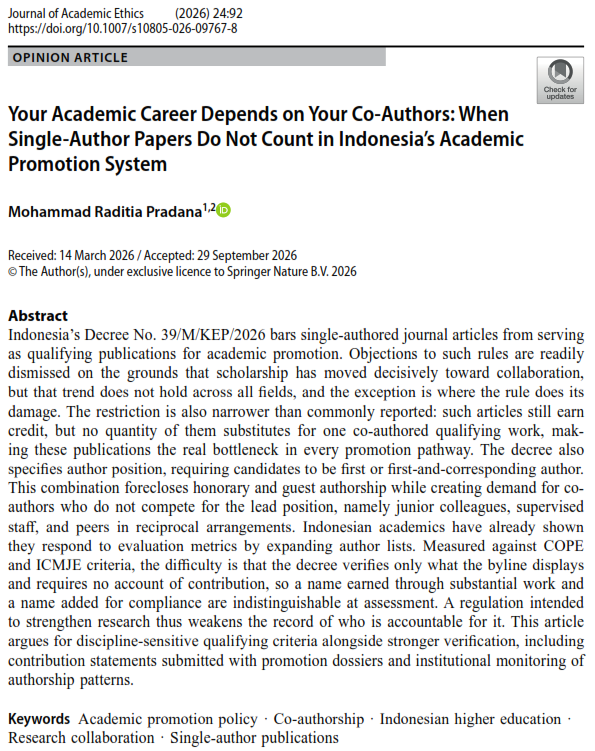
Indonesia’s Decree No. 39/M/KEP/2026 bars single-authored journal articles from serving as qualifying publications for academic promotion. Objections to such rules are readily dismissed on the grounds that scholarship has moved decisively toward collaboration, but that trend does not hold across all fields, and the exception is where the rule does its damage. The restriction is also narrower than commonly reported: such articles still earn credit, but no quantity of them substitutes for one co-authored qualifying work, making these publications the real bottleneck in every promotion pathway. The decree also specifies author position, requiring candidates to be first or first-and-corresponding author. This combination forecloses honorary and guest authorship while creating demand for co-authors who do not compete for the lead position, namely junior colleagues, supervised staff, and peers in reciprocal arrangements. Indonesian academics have already shown they respond to evaluation metrics by expanding author lists. Measured against COPE and ICMJE criteria, the difficulty is that the decree verifies only what the byline displays and requires no account of contribution, so a name earned through substantial work and a name added for compliance are indistinguishable at assessment. A regulation intended to strengthen research thus weakens the record of who is accountable for it. This article argues for discipline-sensitive qualifying criteria alongside stronger verification, including contribution statements submitted with promotion dossiers and institutional monitoring of authorship patterns.
Your Academic Career Depends on Your Co-Authors: When Single-Author Papers Do Not Count in Indonesia’s Academic Promotion System
Mohammad Raditia Pradana# (# corresponding author)
Journal of Academic Ethics 2026
Indonesia’s Decree No. 39/M/KEP/2026 bars single-authored journal articles from serving as qualifying publications for academic promotion. Objections to such rules are readily dismissed on the grounds that scholarship has moved decisively toward collaboration, but that trend does not hold across all fields, and the exception is where the rule does its damage. The restriction is also narrower than commonly reported: such articles still earn credit, but no quantity of them substitutes for one co-authored qualifying work, making these publications the real bottleneck in every promotion pathway. The decree also specifies author position, requiring candidates to be first or first-and-corresponding author. This combination forecloses honorary and guest authorship while creating demand for co-authors who do not compete for the lead position, namely junior colleagues, supervised staff, and peers in reciprocal arrangements. Indonesian academics have already shown they respond to evaluation metrics by expanding author lists. Measured against COPE and ICMJE criteria, the difficulty is that the decree verifies only what the byline displays and requires no account of contribution, so a name earned through substantial work and a name added for compliance are indistinguishable at assessment. A regulation intended to strengthen research thus weakens the record of who is accountable for it. This article argues for discipline-sensitive qualifying criteria alongside stronger verification, including contribution statements submitted with promotion dossiers and institutional monitoring of authorship patterns.
Indonesia’s urban green spaces dilemma: Balancing law, ecology, and public space, highlighting Jakarta
Mohammad Raditia Pradana#, Jarot Mulyo Semedi (# corresponding author)
Human Geography 2026
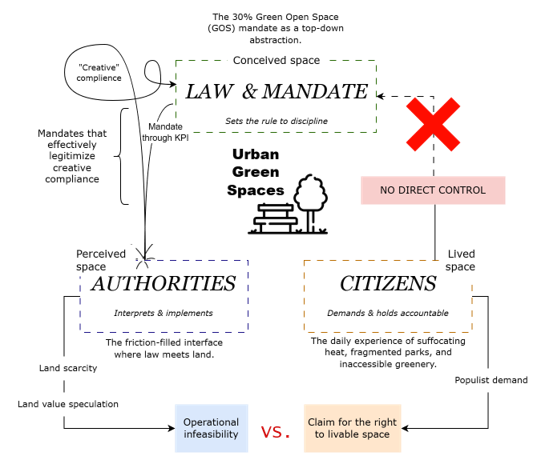
This article intervenes in debates on how law, ecology, and urban governance produce the idea of “green space.” Using Indonesia's 30% Green Open Space (GOS) mandate as a critical case, it argues that the legal abstraction of ecology into measurable quotas transforms environmental care into bureaucratic representation. In Jakarta, where land scarcity and political competition make the target unattainable, compliance is performed through the counting of roadside strips, cemeteries, and ornamental medians as green space. Drawing on Lefebvre's concept of the production of space, Harvey's spatial justice, and Jacobs's notion of lived urban vitality, the article shows how this abstraction privileges visibility and legitimacy over ecological function. Jakarta exemplifies a global urban condition in which sustainability becomes esthetic, green space becomes arithmetic, and law becomes landscape. The debates call for a redefinition of GOS as spatial care—a relational practice that distinguishes but connects ecological integrity and public accessibility. Moving beyond green quotas toward spatial care, it invites urban geography to reconsider how space is known, governed, and lived in the name of sustainability.
Indonesia’s urban green spaces dilemma: Balancing law, ecology, and public space, highlighting Jakarta
Mohammad Raditia Pradana#, Jarot Mulyo Semedi (# corresponding author)
Human Geography 2026
This article intervenes in debates on how law, ecology, and urban governance produce the idea of “green space.” Using Indonesia's 30% Green Open Space (GOS) mandate as a critical case, it argues that the legal abstraction of ecology into measurable quotas transforms environmental care into bureaucratic representation. In Jakarta, where land scarcity and political competition make the target unattainable, compliance is performed through the counting of roadside strips, cemeteries, and ornamental medians as green space. Drawing on Lefebvre's concept of the production of space, Harvey's spatial justice, and Jacobs's notion of lived urban vitality, the article shows how this abstraction privileges visibility and legitimacy over ecological function. Jakarta exemplifies a global urban condition in which sustainability becomes esthetic, green space becomes arithmetic, and law becomes landscape. The debates call for a redefinition of GOS as spatial care—a relational practice that distinguishes but connects ecological integrity and public accessibility. Moving beyond green quotas toward spatial care, it invites urban geography to reconsider how space is known, governed, and lived in the name of sustainability.
Harmonizing street-view semantics and spatial predictors for dominant urban visual composition modelling
Mohammad Raditia Pradana#, Muhammad Dimyati, Ahmad Gamal (# corresponding author)
Computational Urban Science 2025 Spotlight
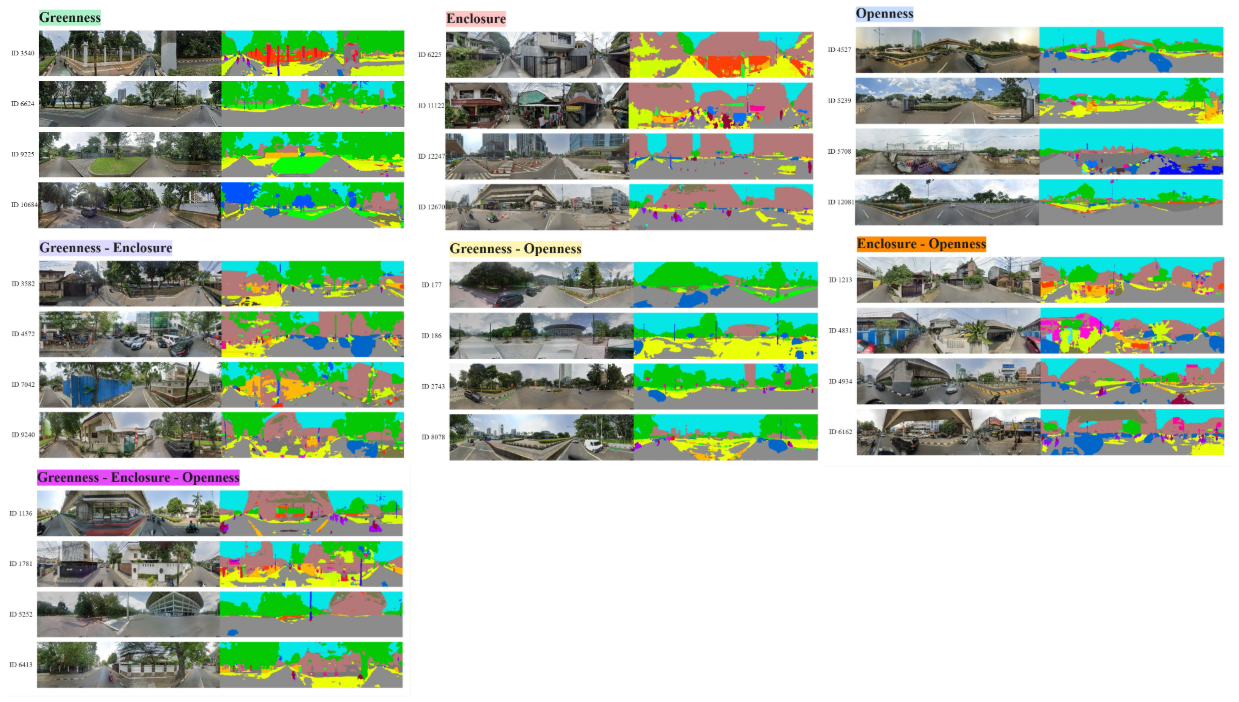
Street-level visual experiences are underrepresented in top-down spatial datasets such as remote sensing and spatial footprints, which predominantly capture configurations from an overhead perspective. This study develops a framework to model and map urban visual dominance, defined through seven typologies based on Greenness, Openness, and Enclosure. A total of 12,631 Google Street View panoramas were semantically segmented with a pretrained ADE20K deep learning model to extract proportions of trees, buildings, and sky. These proportions were aggregated into 50 m hexagonal grids and classified into visual dominance classes through rule-based logic. To predict these classes beyond street-view coverage, three scenarios of spatial predictors (remote sensing indices, building footprints, and their combination) were evaluated using five machine learning algorithms. Logistic Regression with combined predictors performed best, achieving an accuracy of 0.503 and an AUC-ROC up to 0.85 for the Greenness class. External validation against GHSL settlement data across six urban sites showed soft accuracy scores ranging from 22.33% to 67.23%, with better performance in structured environments than in fragmented residential settings. These findings highlight both the promise and limitations of generalizing street-view visual information from two-dimensional spatial features, offering a scalable approach to bridge the spatial coverage gap and support more human-centered urban landscape analysis.
Harmonizing street-view semantics and spatial predictors for dominant urban visual composition modelling
Mohammad Raditia Pradana#, Muhammad Dimyati, Ahmad Gamal (# corresponding author)
Computational Urban Science 2025 Spotlight
Street-level visual experiences are underrepresented in top-down spatial datasets such as remote sensing and spatial footprints, which predominantly capture configurations from an overhead perspective. This study develops a framework to model and map urban visual dominance, defined through seven typologies based on Greenness, Openness, and Enclosure. A total of 12,631 Google Street View panoramas were semantically segmented with a pretrained ADE20K deep learning model to extract proportions of trees, buildings, and sky. These proportions were aggregated into 50 m hexagonal grids and classified into visual dominance classes through rule-based logic. To predict these classes beyond street-view coverage, three scenarios of spatial predictors (remote sensing indices, building footprints, and their combination) were evaluated using five machine learning algorithms. Logistic Regression with combined predictors performed best, achieving an accuracy of 0.503 and an AUC-ROC up to 0.85 for the Greenness class. External validation against GHSL settlement data across six urban sites showed soft accuracy scores ranging from 22.33% to 67.23%, with better performance in structured environments than in fragmented residential settings. These findings highlight both the promise and limitations of generalizing street-view visual information from two-dimensional spatial features, offering a scalable approach to bridge the spatial coverage gap and support more human-centered urban landscape analysis.
Tracking Urban Sprawl: A Systematic Review and Bibliometric Analysis of Spatio-Temporal Patterns Using Remote Sensing and GIS
Mohammad Raditia Pradana#, Muhammad Dimyati (# corresponding author)
European Journal of Geography 2024
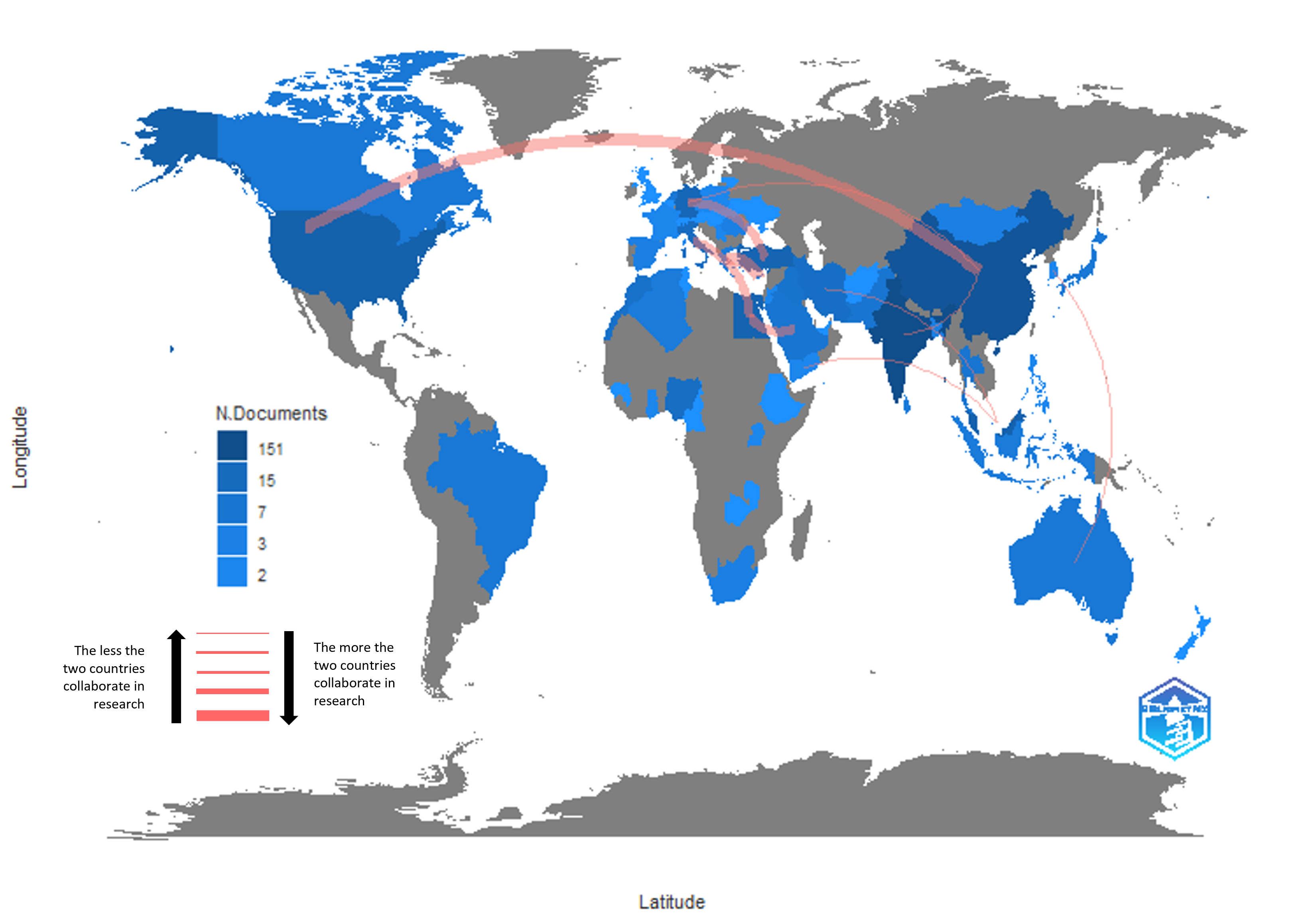
The urban sprawl phenomenon refers to the expansion of urban areas driven by high population growth and migration. A spatio-temporal approach is indispensable in urban sprawl research. Monitoring and evaluating urban sprawl in a region is crucial for controlling drastic environmental changes. Integrated Remote Sensing (RS) and Geographic Information System (GIS) technologies can serve as essential tools for this purpose. The aim of this systematic literature review paper is to gather information on the latest data, methods, and findings to be considered in future urban sprawl research. The PRISMA method was employed, involving filtering from the Scopus database, resulting in 30 papers selected for an in-depth review to address the objectives of this paper. Landsat data remains the preferred choice for monitoring changes due to its extensive historical archive compared to other data sources. Landscape metrics represent a more advanced method com-pared to conventional change detection in quantifying urban sprawl. Other indices and quantifiers are also used to support the quantification of urban sprawl. Two perspectives exist in selecting the study's temporal intervals: consistent and inconsistent, which are adjusted based on the natural characteristics of "change," namely "abrupt" and "gradual." Suggestions for future research include using data with detailed spatial resolution and narrow study intervals while considering the patterns of urban sprawl formation.
Tracking Urban Sprawl: A Systematic Review and Bibliometric Analysis of Spatio-Temporal Patterns Using Remote Sensing and GIS
Mohammad Raditia Pradana#, Muhammad Dimyati (# corresponding author)
European Journal of Geography 2024
The urban sprawl phenomenon refers to the expansion of urban areas driven by high population growth and migration. A spatio-temporal approach is indispensable in urban sprawl research. Monitoring and evaluating urban sprawl in a region is crucial for controlling drastic environmental changes. Integrated Remote Sensing (RS) and Geographic Information System (GIS) technologies can serve as essential tools for this purpose. The aim of this systematic literature review paper is to gather information on the latest data, methods, and findings to be considered in future urban sprawl research. The PRISMA method was employed, involving filtering from the Scopus database, resulting in 30 papers selected for an in-depth review to address the objectives of this paper. Landsat data remains the preferred choice for monitoring changes due to its extensive historical archive compared to other data sources. Landscape metrics represent a more advanced method com-pared to conventional change detection in quantifying urban sprawl. Other indices and quantifiers are also used to support the quantification of urban sprawl. Two perspectives exist in selecting the study's temporal intervals: consistent and inconsistent, which are adjusted based on the natural characteristics of "change," namely "abrupt" and "gradual." Suggestions for future research include using data with detailed spatial resolution and narrow study intervals while considering the patterns of urban sprawl formation.
All publications
Ongoing Projects (view all )

Cooling Cities, Warming Communities: Quantifying Climate Resilience in Urban Parks Through Anthropomorphic Mapping and Place Attachment
Investigates climate resilience in urban green spaces by integrating anthropomorphic mapping, place attachment analysis, and street-view imagery to understand the relationship between human perception and adaptive urban landscape design.
Cooling Cities, Warming Communities: Quantifying Climate Resilience in Urban Parks Through Anthropomorphic Mapping and Place Attachment
Investigates climate resilience in urban green spaces by integrating anthropomorphic mapping, place attachment analysis, and street-view imagery to understand the relationship between human perception and adaptive urban landscape design.
Project page
Prompting Sustainability: A Comparative Analysis of How Generative AI Interprets and Visualizes Urban 'Sustainable' Streetscapes
Examines how generative AI models interpret and visualize sustainable urban streetscapes through prompt-based analysis, evaluating how AI-generated imagery reflects principles of sustainable urban design and planning.
Prompting Sustainability: A Comparative Analysis of How Generative AI Interprets and Visualizes Urban 'Sustainable' Streetscapes
Examines how generative AI models interpret and visualize sustainable urban streetscapes through prompt-based analysis, evaluating how AI-generated imagery reflects principles of sustainable urban design and planning.
Project page